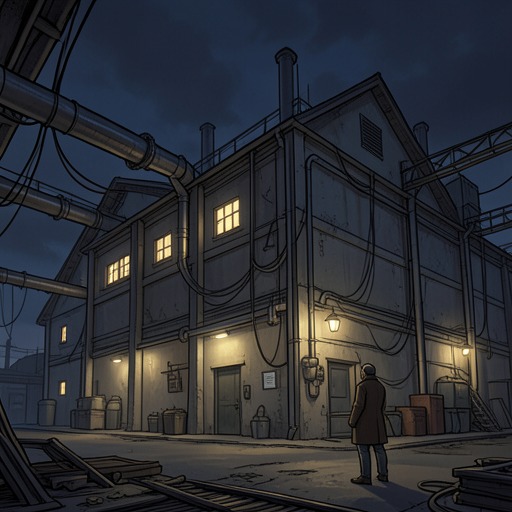
Black Creek Power-house
Earth AbidesBlack Creek Power-house is a hydroelectric facility whose familiar sounds and machinery reassure Ish just before the disaster becomes unmistakable. Its apparent reliability later gives way to a larger lesson: electricity can continue flowing without its operators for a time, but the system depends on small, recurring acts of maintenance that cannot be abandoned indefinitely.
Setting and First Appearance
After leaving the Johnsons’ store, Ish drives along a road winding between pine groves beside a rushing stream. His hand is no longer hurting much, and he feels nearly recovered from his illness. Although the empty store and other recent absences have unsettled him, by the time he reaches Black Creek Power-house he has regained his composure.
The facility appears unchanged. Ish hears the large generators whirring and sees water foaming beneath the buildings; a light still burns on the bridge. He assumes that the electricity is plentiful enough that no one needs to bother switching it off. The working machinery makes the absence of people seem unremarkable: the process appears nearly automatic, and the few employees are usually indoors.
The Dog and Ish’s Misreading
As Ish is leaving, a large collie runs from behind one of the buildings and barks violently at him from the other side of the creek. It runs back and forth, but Ish dismisses its alarm as foolishness, even wondering whether it thinks he intends to steal the power-house. He considers the dog’s presence another sign of ordinary life and drives on, whistling contentedly toward Hutsonville.
The scene turns on a gap between what Ish sees and what the reader can infer. The barking is an urgent disturbance in an otherwise reassuring landscape, but Ish reads it as familiar animal behavior rather than a warning. The power-house seems to confirm that the social world still functions because its machines do; the unheeded dog exposes how little that visible normality proves.
A Network That Outlasts Its Operators
The power system initially continues to work after the disaster begins. Its generators keep sending precisely timed pulses through the wires even as the men fall sick and die. If a wire breaks, the system redirects power before the wire falls; if one power-house fails, others in the network, which stretches across hundreds of miles, rapidly take up the load. Black Creek Power-house belongs to the landscape of this apparently resilient electrical infrastructure, though the account does not identify it as a particular facility that later fails.
The network’s weakness lies not in its great generators or in the continued flow of water, but in the governors controlling the generators. These mechanisms still require inspection for oil every ten days and may need more oil each month. After two months without care, their oil supplies run low; as governors fail, water no longer strikes the wheels, individual generators stop, and the remaining machines bear an increasing load. The cascading decline makes the earlier appearance of effortless operation newly legible: automatic adjustment can absorb disruption, but it cannot replace maintenance forever.
Infrastructure and the Limits of Continuity
The power-house’s story belongs to the novel’s wider attention to systems whose vulnerabilities are easy to overlook while they work. On San Lupo Drive, leaves plugging a drain redirect rainwater across a street and through a garden; elsewhere, a defective section of the main aqueduct gradually leaks as corrosion advances. These are different infrastructures, but each depends on human beings noticing and repairing small failures before they grow consequential.
Black Creek Power-house thus gives the collapse a material, incremental shape. Its roaring generators and bright bridge light persist beyond the people who once tended them, yet that persistence is temporary. The facility marks the distinction between machinery that can keep running through the first shock and a functioning system that can endure without care.